Africa abounds with space centres of excellence
13 December 2023
30 June 2026



AUTHOR: Vuyolwethu Mahlalela
Emerging space ecosystems are trying to move from strategy and pilots to reliable delivery of space-enabled services and supporting infrastructure. Yet across ecosystems at different maturity levels, employers continue to report skills gaps and hiring difficulty despite growing investment in training and upskilling. The challenge is not only how many people are trained, but whether ecosystems can convert capability into usable work at the pace their goals require.
At first glance, this appears to be a straightforward training problem. Universities launch new programmes, short courses proliferate, and self-taught learners build portfolios and freelance in the downstream. Yet, employers still struggle to hire, delivery capacity remains thin and early-career professionals struggle to find stable roles.
Our point of view is that training supply matters, but it is rarely sufficient on its own. In emerging space ecosystems such as Kenya, a pattern we often see is that systems often overproduce what is easy to learn and underproduce what is hard to train. This dynamic tends to intensify when:
This article recommends a shift from asking “how many people are trained?” to “what capabilities does the market need, and whether the ecosystem can convert capability into work at the pace required to meet its goals?”
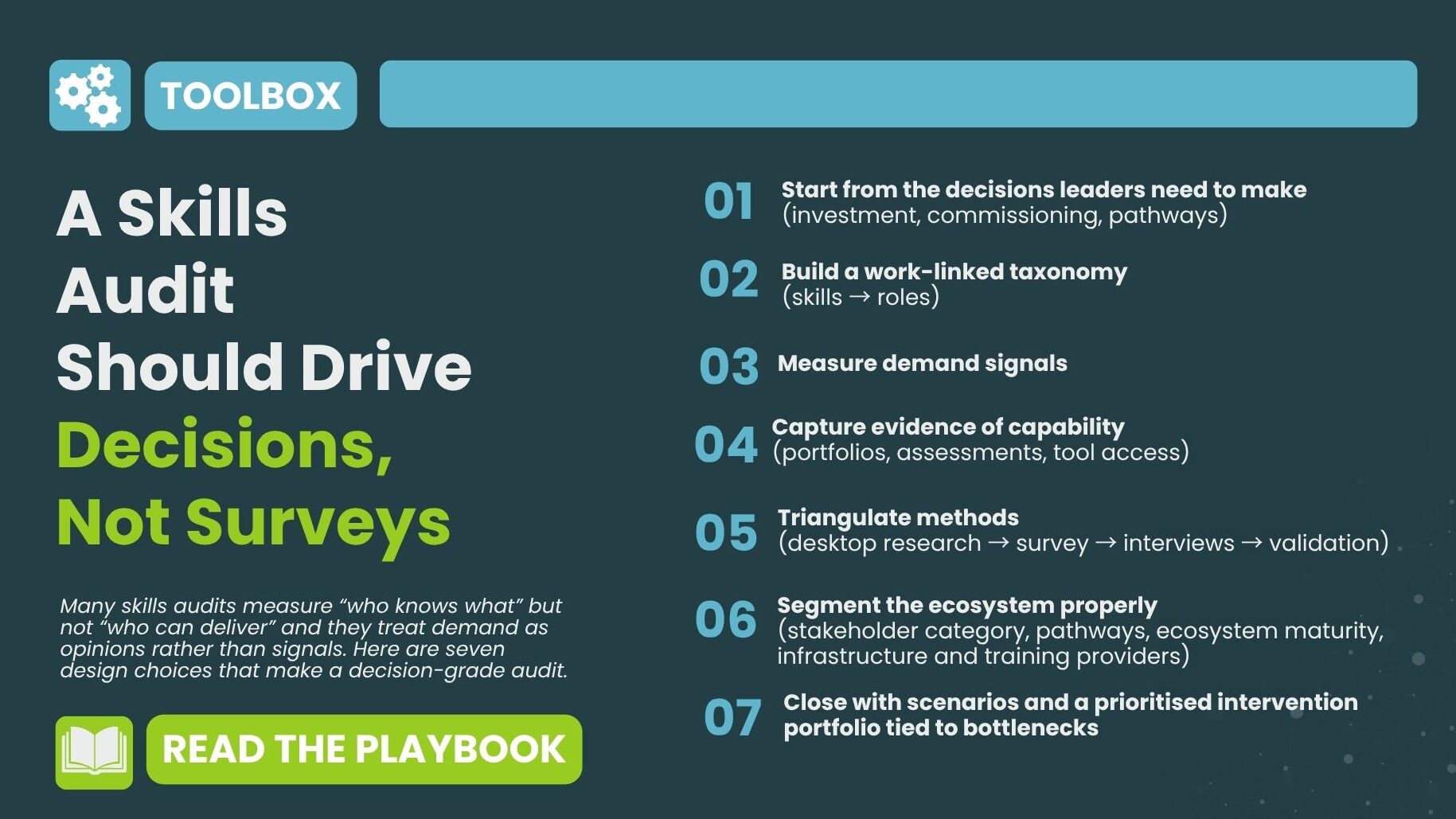
It also links to a practical playbook that walks you through running a decision-grade ecosystem skills audit as a labour-market instrument, rather than a once-off survey.
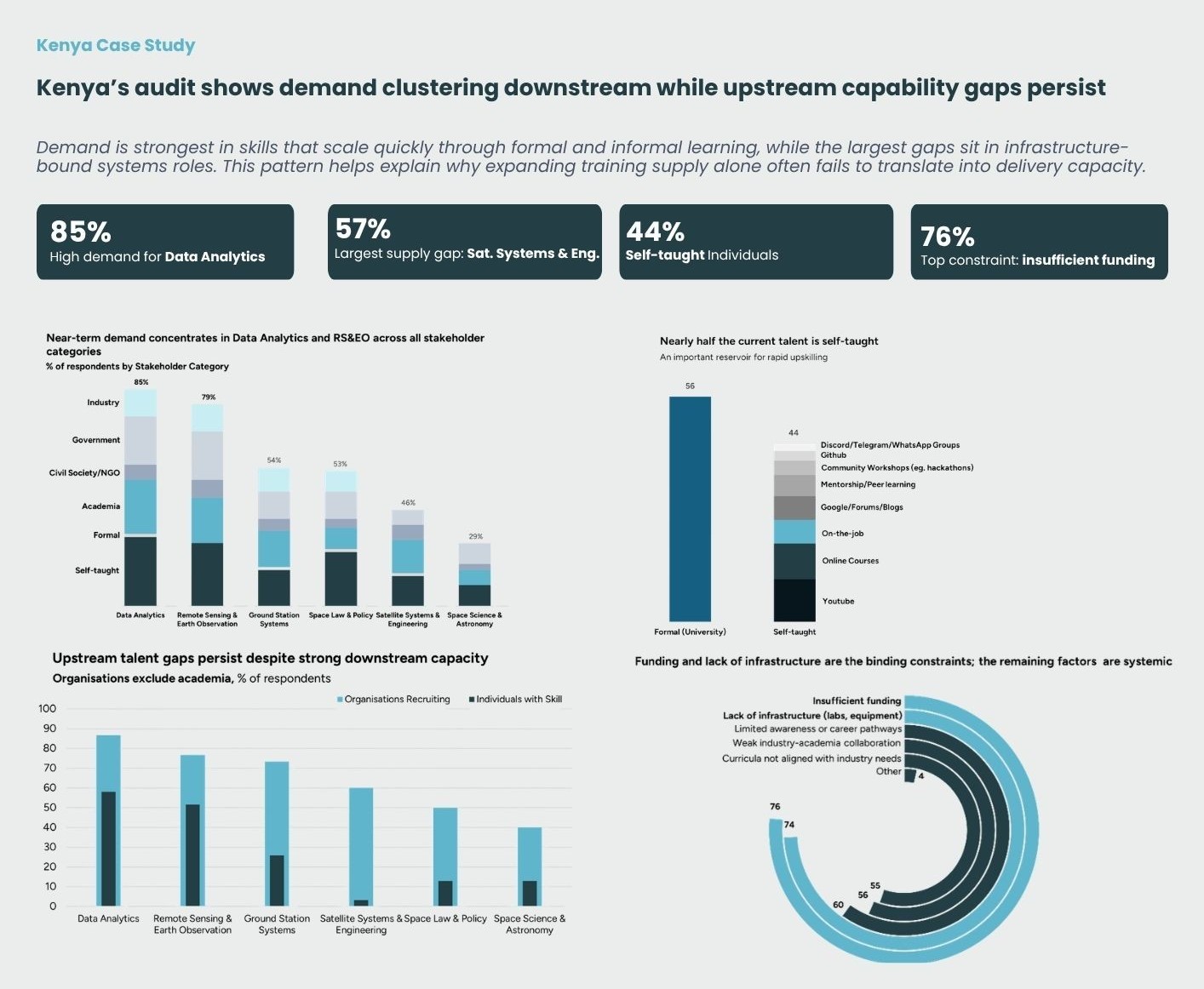
Kenya’s space ecosystem’s skills audit provides a grounded example of an ecosystem-wide skills audit. It revealed strong near-term demand for downstream, data-centric capabilities and significant gaps in infrastructure-heavy upstream roles. It also showed a workforce formed through hybrid learning pathways and binding constraints, particularly funding, infrastructure, and limited awareness of space career paths. Taken together, these findings suggest that the challenge is not only whether capability exists but whether the ecosystem can convert that capability into delivery and sustained roles where it is most needed.
Most conversations about skills start with a supply question: Do you have enough people with the right skills? The supply question is necessary, but on its own, it is incomplete. The skills audit in Kenya highlights a clear supply-demand gap in critical technical areas.
A better question is how ecosystems decide which skills to produce. An equally important one is whether those skills can be built to a delivery-ready standard. This means that people can use the right tools, processes and quality standards to complete real client work. When demand signals are weak and career pathways are unclear, learners and institutions gravitate towards skills that are visible and feasible to learn with minimal infrastructure. The result is that some capability areas scale quickly, while others lag despite being strategically important.
Even where capability exists or is forming, it does not automatically translate into stable roles and delivery capacity. People may complete broad degrees and still need to self-teach niche skills to find work or freelance. Employers may report demand and still struggle to hire. This is where conversion becomes binding.
Exhibit 1: Skills strategies deliver impact when demand signals translate into supply, conversion, and absorption.
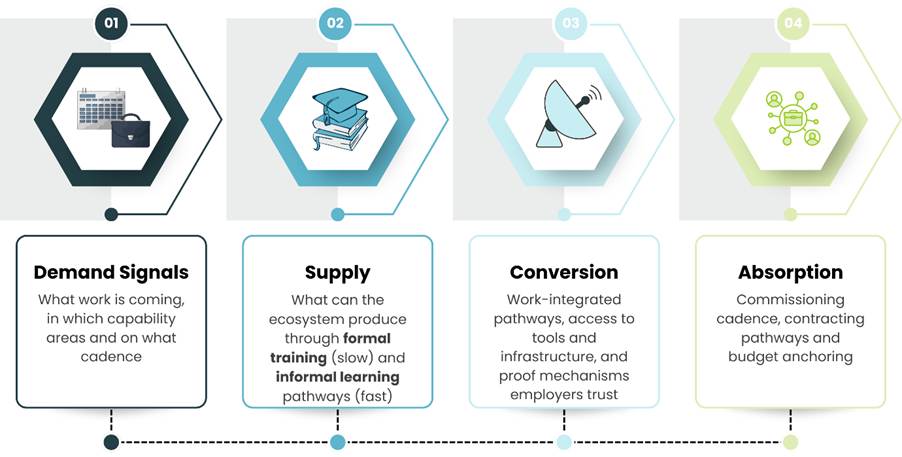
In this pipeline, conversion refers to the mechanisms that move people from learning to employability and from employability to demonstrable delivery and ultimately into sustained roles. Absorption refers to the system’s ability to create and sustain roles through commissioning, hiring and repeat work.
A key structural reality is that capability supply does not scale uniformly. Instead, it tends to move at two distinct speeds.
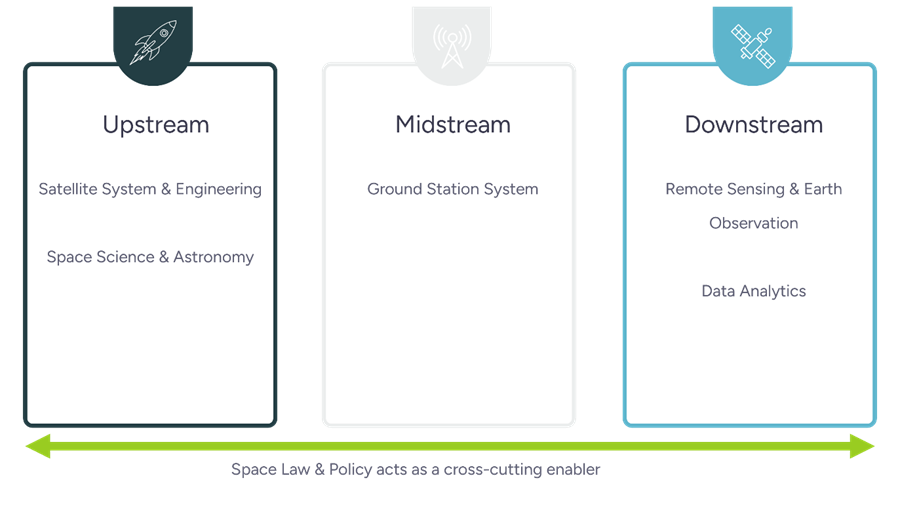
In space ecosystems, this two-speed dynamic maps closely to where capabilities sit along the value chain. Downstream applications and data skills typically scale faster, while upstream systems skills are more tied to infrastructure. This means that training alone will tend to expand downstream capability while leaving infrastructure-bound gaps unresolved.
Exhibit 2: Common space capability areas cluster upstream, midstream and downstream, with space law and policy acting as a cross-cutting enabler.
When demand is unclear and enabling conditions are constrained, the fast-moving capabilities proliferate while infrastructure-bound capability formation lags. This explains why scaling training volume alone often produces low returns. It expands what is easiest to produce, not necessarily what the sector needs most. It also does not automatically translate into jobs if absorption and conversion mechanisms remain weak.
Based on the Kenya case and patterns that show up in other ecosystems, we argue that closing skills gaps is not about training more people; it is about turning learning into employable delivery capacity. That requires four conversion mechanisms that move demand into job-ready capability, capability into deliverables, and deliverables into sustained roles. This matters most in infrastructure-intensive areas, where supply can’t grow without practice environments and supervised pathways.
The practical implication is that building capability is not enough; ecosystems must also help convert that capability into delivery and sustained roles. The full solution varies by ecosystem, but these actions strengthen conversion almost everywhere because they target the mechanisms above. They also reflect the two-speed reality that downstream skills are fast-moving when demand is visible, while upstream skills are slow-moving because they require deliberate investment in infrastructure and supervised pathways.
Make demand visible and predictable

Build conversion pathways around real work, especially for infrastructure-bound roles

Make pathways and capabilities visible

These moves do not replace training. They ensure that training translates into employable capability and that that capability compounds into delivery capacity rather than leaking into adjacent sectors or freelance work.
What ultimately determines whether a skills strategy is working is not the volume of training, but whether the ecosystem can convert capability into delivered work and, in turn, deliver sustained roles. In the pipeline shown in Exhibit 1, that means managing the last two boxes: increasing local delivery capacity on priority briefs and raising the share of people who transition into and stay relevant roles. When measurement follows these outcomes, commissioning can follow what works.
A more useful dashboard shifts from “people trained” to “people converted into delivery,” such as:
In our view, the Kenya Space Skills Audit illustrates a broader lesson that skills gaps are real, and they persist when ecosystems scale what is easiest to train while under-investing in what is hardest to build. Without stronger demand signals, visible pathways, tools and credible assessments, ecosystems struggle to translate capability into delivery at the pace strategic goals require.
For sector bodies, agencies and ecosystem leaders looking to accelerate growth, the most practical next step is clear: commission a decision-grade, ecosystem-wide skills audit, not as a report but as a steering instrument to align demand and supply, prioritise enabling investments and build pathways that convert capability into sustained work.
Share On:

1 October 2026
CLIENT: Minerals Council South AfricaFOCUS: GIS, data analytics, community engagement and mining operations The mining…

4 September 2026
AUTHOR: Tswelopele Makgale South Africa’s ongoing energy crisis remains a significant barrier to the country’s socio-economic growth.…

30 June 2026
AUTHOR: Vuyolwethu Mahlalela Emerging space ecosystems are trying to move from strategy and pilots to…
